Turn your passion for aviation into a professional path. Commercial flying begins with a strong foundation, then builds through advanced ratings, flight experience and training toward opportunities in airlines, cargo, charter and specialized aviation operations.
Understanding the Journey
Commercial flying offers the chance to turn a passion for aviation into a rewarding career. For those aspiring to fly professionally, the journey can be a long process depending on the career they are pursuing.
Either way, it begins with a strong foundation in aeronautical knowledge and flight training. Then, after earning the major certifications and ratings, those pursuing the ATP path face the challenge of building flight hours, gaining experience in diverse flying conditions and mastering the skills needed to meet the FAA’s rigorous standards.
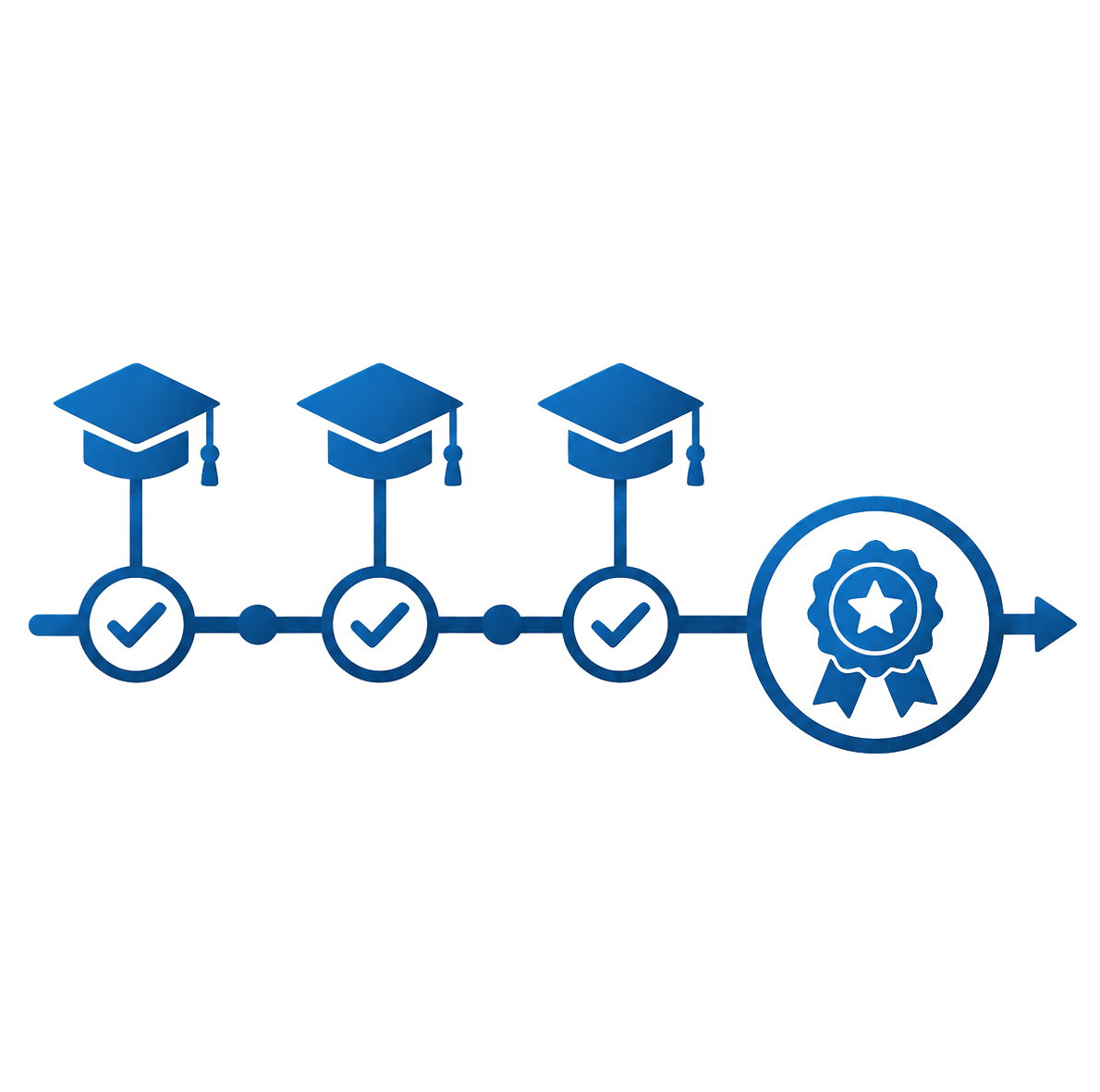
Commercial Foundation
Build essential flying skills and a strong base in aeronautical knowledge through the Private Pilot Certificate (PPL), Instrument Rating and Commercial Pilot Certificate (CPL).
Advanced Qualifications
Add a Multi-Engine Rating or earn Flight Instructor certificates. While not required for every career path, these often become necessary to build flight time and expand career options.
Career Opportunities
Explore different career opportunities depending on the path you choose, from specialized aerial operations and flight instruction to airlines, cargo, charter and rescue operations.
Before choosing a commercial training path, it helps to understand how FAA training rules are organized and how Part 61 and Part 141 programs differ.

In aviation, a “Part” refers to specific sections of the Federal Aviation Regulations (FARs) that govern various aspects of aviation activities, from pilot training to aircraft maintenance and operational rules.
Each “Part” in the FARs is a chapter covering distinct rules and requirements set by the Federal Aviation Administration (FAA). These Parts are grouped under Title 14 of the Code of Federal Regulations (CFR), which deals specifically with aeronautics and space.
What is a Part?
Key Parts for Pilot Training
Part 61: Outlines the regulations for obtaining various pilot licenses and ratings. This Part is designed for flexible, instructor-led training that can be tailored to individual needs and schedules.
Part 141: Sets the standards for FAA-approved flight schools. These schools must follow a structured, FAA-approved syllabus and are regularly inspected, offering a more rigorous training pathway.

Key Parts for Flight Operations
Part 91: Details general operating and flight rules applicable to all civil aviation operations in the U.S., covering everything from pre-flight procedures to in-flight regulations.
Part 121: Governs scheduled air carriers, such as commercial airlines, including those that operate larger passenger and cargo aircraft. Part 121 outlines stringent requirements for operations, pilot qualifications, maintenance, safety procedures, and crew training, ensuring safety and reliability in commercial airline services.
Part 135: Governs commercial operations, including charter flights and on-demand air taxi services, with stricter requirements than those under Part 91...
Choosing Between Part 61 & Part 141
The first training decision is usually whether to follow a flexible Part 61 path or a more structured Part 141 program.
| Part 61 | Part 141 | |
|---|---|---|
| PPL |
|
|
| Instrument Rating |
|
|
| CPL |
Required min. 250h total time
|
Required min. 190h total time
|
| ATP |
Required min. 1500h total time
|
Required min. 1000h total time if obtained a Bachelor’s degree with an aviation major
|
Training Path Takeaways
Both Part 61 and Part 141 lead to the same FAA certifications. The FAA exams and practical test standards are the same for both paths.
Part 141 is more structured. It follows a rigorous FAA-approved syllabus, a set training sequence, frequent stage checks and detailed progress records.
Part 61 is more flexible. Students can progress at their own pace with a curriculum tailored to their schedule, needs and learning style. With a strong training plan, Part 61 can be just as rigorous as Part 141.
The required training time and amount of dual instruction can vary. Part 141 may require fewer total flight hours, but most students receive more dual instruction than the minimum required under either path.
Note for International Students
Only SEVP-certified flight schools, generally FAA-approved Part 141 or Part 142 schools, can issue a Form I-20, which may be required to apply for a student visa, such as an F-1 or M-1.
If you choose a Part 61 program or a school that cannot issue an I-20, you may need to secure your visa independently.
Please contact the U.S. embassy or consulate in your country to confirm your options.
Both part 61 and part 141 have their pros and cons. Choose the training path that fits your availability, learning style and need for structure. In the end, the results of your training depends on your dedication and what you expect from yourself.
Whether you choose Part 61 or Part 141, the overall path toward professional flying is largely the same. The main difference is the minimum flight time required at certain stages. Since Part 61 generally requires more time-building, we’ll use it as the example to understand what it takes to progress from your first certificate toward a professional pilot career.
A step-by-step look at the certificates, ratings and flight experience that build toward a professional pilot career. Click the pulsing icons to explore each step.
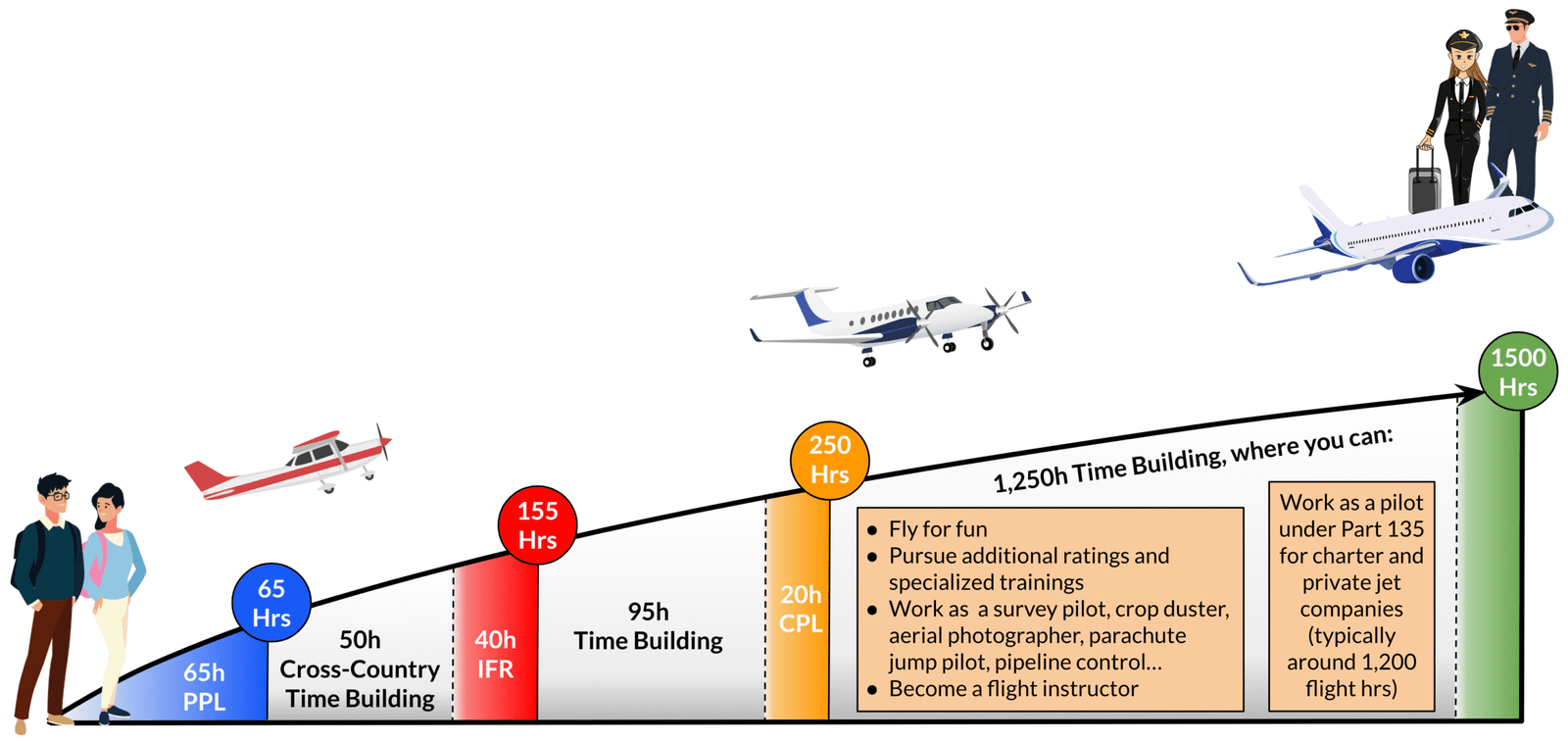
50 hours of cross-country time building requires flying to and landing at an airport at least 50 NM (in a straight line) from the departure airport. This can be done solo, with passengers, or as a safety pilot. You can also incorporate IFR training during your cross-country flights. (Approx. $8,500)
95 hours time building, which may vary depending on your training schedule, provides an opportunity to refine maneuvers, complete longer cross-country flights, and build practical experience. To accumulate hours with purpose, consider volunteering through an association… while it won’t cover expenses, it’s a rewarding way to make a positive impact. A cost-effective approach is to fly with another pilot, alternating roles as pilot or safety pilot, allowing you to practice IFR flying while sharing costs. (Approx. $15,000/$8000 shared)
1,250 hours time building can be the most challenging. Even with a CPL, finding low-hour pilot jobs can be difficult due to limited experience. Around 500-600 hours, roles in pipeline patrol, aerial surveying, banner towing, and crop dusting become more accessible. Most pilots nowadays go directly into instructing after obtaining their CPL, which is one option… whether or not it’s the best path is another debate. Consider pursuing additional ratings, such as multi-engine, or specialized training in areas like mountain flying or aerobatics, to make you a safer, more skilled pilot, serving you well in your aviation career.
Time building in aviation is an essential phase to accumulate the flight hours required for advanced certifications and career opportunities. During this period, you focus on gaining diverse flying experiences in various weather conditions, airspaces, and aircraft.
Min. Flight Training Req.: 40h
Average Flight Training: 65h
Average Cost: $17,000
The Private Pilot Certificate, or PPL, is the first step for aspiring commercial pilots, building foundational skills in flight operations, navigation, and decision-making. This certification allows you to fly small aircraft and carry passengers, providing essential experience for advanced training and a career in aviation.
While you can’t be paid for flights, you’re eligible to participate in certain activities, like search and rescue missions, charity events, and glider towing with additional training. However, you’re not permitted to fly in clouds or poor visibility conditions without first obtaining an instrument rating, which equips you to navigate safely when visibility is limited.
Flying requires extensive knowledge and demands intensive study. Becoming a pilot isn’t easy, but a well-designed ground school program can make it fun and engaging. You’ll also need to learn aviation’s unique “language” and radio communications, which can be particularly challenging for foreign students. Another difficulty is mastering multitasking in the cockpit, where you must divide your attention effectively while maintaining situational awareness.
Min. Flight Training Req.: 15h
Recomm. Flight Training: 40h
Average Cost: $11,000
The Instrument Rating, or IR, allows pilots to fly in low visibility conditions, such as clouds or fog, by relying on instruments for navigation. Most of the training will involve navigation, approaches, and IFR procedures in simulated instrument conditions, where you’ll wear a hood or glasses that obstruct your view outside the cockpit. You may also have the opportunity to fly in actual Instrument Meteorological Conditions (IMC), providing valuable exposure to the effects of limited visibility and real-world Instrument Flight Rules (IFR) challenges, such as disorientation.
Your IR will expand your flight capabilities by reducing weather-related limitations on where and when you can fly. It will also allow you to operate above 18,000 feet MSL, or in Class A airspace, which is accessible only to IR-certified pilots.
Training to fly under IFR, enhances flight safety but is also more complicated than it may seem, as it involves managing disorientation, the absence of outside visual cues, and an intensive cockpit workload, which can feel overwhelming. Mastering multitasking becomes more critical than ever under these conditions.
Min. Flight Training Req.: 20h
Average Flight Training: 20h
Average Cost: $6,000…
The Commercial Pilot Certificate, or CPL, is a crucial step for pilots aiming to pursue aviation as a profession. This certification builds on skills developed in private pilot and instrument training, with an emphasis on precision. While similar to the PPL, the CPL includes additional advanced maneuvers and requires mastering all maneuvers to a higher standard of accuracy, preparing pilots for the demands of professional aviation.
With a CPL, you are permitted to be compensated for your flying, opening doors to careers in charter, flight instruction, banner towing, crop dusting, parachute jumping, aerial surveying, pipeline patrol, air tours, aerial photography, medical transport, and other commercial operations.
The CPL is considered one of the easier licenses to obtain, as it consolidates the knowledge and experience accumulated during previous training. The primary distinction lies in performing all maneuvers to a higher standard of accuracy, building on the skills developed in prior certifications.
Min. Flight Training Req.: 25h
Average Flight Training: 25h
Average Cost: $5,500
The Airline Transport Pilot Certificate, or ATP, is the highest level of pilot certification, required for those who wish to become airline pilots or work for major cargo companies. Earning an ATP demands extensive experience, advanced knowledge of aviation regulations, weather, aircraft systems, and a high degree of precision in flying skills. This certification emphasizes advanced decision-making, crew resource management, and the ability to operate large, multi-engine aircraft in challenging environments. It not only demonstrates your commitment and expertise as a pilot but also qualifies you for significant responsibilities in the air carrier industry, making it the final and most respected step in a pilot’s career progression.
As an ATP, you’ll be eligible to fly as an air carrier pilot. While ongoing training for currency and additional type ratings is required, a key limitation is that ATP privileges end at age 65, after which other piloting roles may still be possible if qualified.
You must maintain a first-class medical certificate, renewed every 6 months after age 40, and undergo regular proficiency tests to ensure operational standards.
Min. Flight Training Required: 40h
Average Flight Training: 65h
Average Cost: $17,000
The Private Pilot Certificate, or PPL, is the first step for aspiring commercial pilots, building foundational skills in flight operations, navigation, and decision-making. This certification allows you to fly small aircraft and carry passengers, providing essential experience for advanced training and a career in aviation.
While you can’t be paid for flights, you’re eligible to participate in certain activities, like search and rescue missions, charity events, and glider towing with additional training. However, you’re not permitted to fly in clouds or poor visibility conditions without first obtaining an instrument rating, which equips you to navigate safely when visibility is limited.
Flying requires extensive knowledge and demands intensive study. Becoming a pilot isn’t easy, but a well-designed ground school program can make it fun and engaging. You’ll also need to learn aviation’s unique “language” and radio communications, which can be particularly challenging for foreign students. Another difficulty is mastering multitasking in the cockpit, where you must divide your attention effectively while maintaining situational awareness.
Min. Flight Training Required: 15h
Recomm. Flight Training: 40h
Average Cost: $11,000
The Instrument Rating, or IR, allows pilots to fly in low visibility conditions, such as clouds or fog, by relying on instruments for navigation. Most of the training will involve navigation, approaches, and IFR procedures in simulated instrument conditions, where you’ll wear a hood or glasses that obstruct your view outside the cockpit. You may also have the opportunity to fly in actual Instrument Meteorological Conditions (IMC), providing valuable exposure to the effects of limited visibility and real-world Instrument Flight Rules (IFR) challenges, such as disorientation.
Your IR will expand your flight capabilities by reducing weather-related limitations on where and when you can fly. It will also allow you to operate above 18,000 feet MSL, or in Class A airspace, which is accessible only to IR-certified pilots.
Training to fly under IFR, enhances flight safety but is also more complicated than it may seem, as it involves managing disorientation, the absence of outside visual cues, and an intensive cockpit workload, which can feel overwhelming. Mastering multitasking becomes more critical than ever under these conditions.
Min. Flight Training Required: 20h
Average Flight Training: 20h
Average Cost: $6,000
The Commercial Pilot Certificate, or CPL, is a crucial step for pilots aiming to pursue aviation as a profession. This certification builds on skills developed in private pilot and instrument training, with an emphasis on precision. While similar to the PPL, the CPL includes additional advanced maneuvers and requires mastering all maneuvers to a higher standard of accuracy, preparing pilots for the demands of professional aviation.
With a CPL, you are permitted to be compensated for your flying, opening doors to careers in charter, flight instruction, banner towing, crop dusting, parachute jumping, aerial surveying, pipeline patrol, air tours, aerial photography, medical transport, and other commercial operations.
The CPL is considered one of the easier licenses to obtain, as it consolidates the knowledge and experience accumulated during previous training. The primary distinction lies in performing all maneuvers to a higher standard of accuracy, building on the skills developed in prior certifications.
Min. Flight Training Required: 25h
Average Flight Training: 25h
Average Cost: $5,500
The Airline Transport Pilot Certificate, or ATP, is the highest level of pilot certification, required for those who wish to become airline pilots or work for major cargo companies. Earning an ATP demands extensive experience, advanced knowledge of aviation regulations, weather, aircraft systems, and a high degree of precision in flying skills. This certification emphasizes advanced decision-making, crew resource management, and the ability to operate large, multi-engine aircraft in challenging environments. It not only demonstrates your commitment and expertise as a pilot but also qualifies you for significant responsibilities in the air carrier industry, making it the final and most respected step in a pilot’s career progression.
As an ATP, you’ll be eligible to fly as an air carrier pilot. While ongoing training for currency and additional type ratings is required, a key limitation is that ATP privileges end at age 65, after which other piloting roles may still be possible if qualified.
You must maintain a first-class medical certificate, renewed every 6 months after age 40, and undergo regular proficiency tests to ensure operational standards.
The pace of your training depends on various factors: your commitment, the effort you put in, the time spent studying, and the quality of instruction. Progress is generally improved by regular flight lessons and a solid foundation of ground knowledge. Students who study thoroughly before beginning intensive flight training often achieve better results, requiring less flight time overall, which can save both time and money.
| Flights per Week | 2–3 | 4–5 |
|---|---|---|
| PPL | 4–5 Months | 2–3 Months |
| 50h Cross Country | 2–3 Months | 1–2 Months |
| IR | 2–3 Months | 1 Month |
| 95h Time Building | 4–5 Months | 2–3 Months |
| CPL | 1 Month | 2 Weeks |
| 1250h Time Building | 2 Years | 1 Year |
| ATP | 1–2 Weeks | |
| Total | 3–4 Years | 2–3 Years |
Training Includes Both Ground Lessons & Flight Lessons
Ground lessons offer dedicated time with your instructor to build the aeronautical knowledge required for your certificate or rating. Coming prepared and studying assigned materials enhances retention, reduces class and flight time, and saves money. Though home study can feel overwhelming, an online ground school can keep you on track, preparing you for your knowledge test and the oral portion of your practical test.
A well-structured flight lesson includes a pre-flight briefing to set objectives, review maneuvers, and address questions, followed by a pre-flight inspection to ensure the aircraft is safe to fly. In-flight, you’ll practice takeoffs, landings, maneuvers, and navigation, gradually taking more control and building accuracy and proficiency. After reaching a certain skill level, solo flights allow you to practice independently, reinforcing skills and building confidence. After the flight, a debriefing provides feedback and sets goals for the next session, with study materials assigned to reinforce learning.
Build the aeronautical knowledge you need with structured ground training designed to help you understand the concepts behind flight, prepare for your FAA written exam and apply that knowledge in the cockpit.
Our website address is: https://myflightacademyusa.com.
We use cookies and similar tracking technologies to enhance your browsing experience, deliver course content, analyze website traffic, and support marketing efforts. When you first visit our site, you are presented with a cookie banner that allows you to accept or reject non-essential cookies in accordance with GDPR and CCPA/CPRA regulations.
Cookies used on our site fall into the following categories:
Essential cookies: These are necessary for basic website functionality such as logging in, securing transactions, and saving your cookie preferences. These cookies are always active and do not require consent.
Analytics cookies: These help us understand how visitors interact with our website (e.g., Google Analytics). These cookies are only activated if you give consent.
Marketing cookies: These cookies, such as those from Omnisend or Vimeo, may be used to deliver personalized content or track your interactions across platforms. These are disabled by default and only activated if you consent via the cookie banner.
Embedded content cookies: Some pages may contain embedded content (e.g., YouTube or Vimeo videos) that behaves as if you visited the external site directly. These third-party sites may set cookies of their own, which are only activated upon user consent.
Please note: Not accepting certain cookies may affect the functionality of the website or parts of the training program. Some features, such as video playback, quiz interaction, or email automation, may be disabled or function incorrectly if cookies are blocked.
You can adjust or revoke your cookie preferences at any time by clicking the “Cookie Settings” link in the footer. This includes full details about the cookies used on our site.
Articles on this site may include embedded content (e.g. videos, images, articles, etc.). Embedded content from other websites behaves in the exact same way as if the visitor has visited the other website.
These websites may collect data about you, use cookies, embed additional third-party tracking, and monitor your interaction with that embedded content, including tracking your interaction with the embedded content if you have an account and are logged in to that website.
We do not sell or directly share your personal information with third parties for commercial purposes. However, we may share limited data with trusted service providers who help us operate our website, process payments, deliver content, or manage communications. These providers include:
Payment processors such as PayPal, to securely process course purchases.
Email and marketing tools such as Omnisend, to manage course notifications and updates.
Analytics providers like Google Analytics, to help us understand user behavior and improve the learning experience.
Embedded content platforms such as Vimeo or YouTube, which may collect data when you play video content hosted on their services.
Each of these partners is bound by their own privacy policies and only receives the information necessary to perform specific services on our behalf.
If you are a California resident, you have the right to opt out of any data sharing that may be considered a “sale” under the California Consumer Privacy Act (CCPA/CPRA). You may exercise this right at any time by clicking the “Do Not Sell or Share My Personal Information” link in the footer of our website or by adjusting your cookie preferences via the Cookie Settings link.
When you purchase a course, you are redirected to PayPal for secure payment processing. After successful payment, you are returned to our site and automatically logged in through our membership system. Your data is securely stored on our servers and is not sent to any third parties beyond those required for payment and account management.
We use PayPal to process payments for course access. When you make a payment, your billing information is handled directly by PayPal and is subject to their privacy policy. We do not store or have access to your full payment details (such as credit card numbers). PayPal’s privacy policy is available at https://www.paypal.com/webapps/mpp/ua/privacy-full.
All products sold on this website are digital and delivered electronically. Upon successful payment, users will receive instructions via email to complete their registration and access the course materials. No physical products are shipped.
By registering on our site or purchasing a course, you agree to receive transactional emails related to your account, course access, and platform updates. We may also send occasional educational or promotional emails if you have opted in. You can unsubscribe from non-essential emails at any time by using the link provided in each email.
We store user data on secure servers located in the United States. Depending on your location, your information may be transferred to and maintained on servers outside your country. By using our site, you consent to this transfer, storage, and processing of your information.
We may use third-party analytics tools (such as Google Analytics) to collect standard internet log information and visitor behavior patterns. This helps us analyze traffic and improve the site experience. These tools may use cookies to track user activity on our website.
If you leave a review on our site, we may collect your name, email address, and any content you provide in the review form. This data is used solely for displaying your feedback and ensuring authenticity. We do not publicly display your email address.
If you have any questions about this Privacy Policy or how your data is handled, you can contact us at: support@myflightacademyusa.com
Last updated: April 17, 2025
By accessing or using this website and its services, you agree to be bound by these Terms and Conditions and our Privacy Policy. If you do not agree with any part of these terms, please do not use the website.
My Flight Academy LLC provides online aviation training courses. All products are digital and access is provided electronically via the email address provided at checkout. No physical products are shipped.
Users are responsible for maintaining the confidentiality of their login credentials. Sharing access or distributing course content without permission is strictly prohibited and may result in account termination and legal pursuit.
All payments are processed securely via PayPal. Upon successful payment, users will receive an email with instructions to access the course. Access is granted to the email address used during checkout.
Due to the digital nature of our courses, all sales are final. We do not offer refunds once access to course content has been granted. Please review course information carefully before purchasing.
All course materials, videos, and written content are the intellectual property of My Flight Academy LLC. You may not copy, distribute, or resell any content without written permission.
We make every effort to ensure the accuracy of course materials but do not guarantee that all content is error-free. My Flight Academy LLC is not liable for any direct or indirect damages resulting from the use of our services.
We reserve the right to update or change these Terms and Conditions at any time. Continued use of the site after any changes indicates acceptance of those changes.
These Terms and Conditions are governed by and construed in accordance with the laws of the State of California, United States. Any disputes arising out of or relating to the use of this website or services shall be resolved in the courts of California.
If you have any questions about these Terms and Conditions, you can contact us at: support@myflightacademyusa.com
Last updated: April 11, 2025
At My Flight Academy, we value your privacy. Under the California Consumer Privacy Act (CCPA) and California Privacy Rights Act (CPRA), residents of California have the right to opt-out of the sale or sharing of their personal information.
While we do not sell your data in the traditional sense, we may use third-party services that help us analyze, market, or improve our educational platform. Some of these services may involve sharing limited information for those business purposes.
You have the right to request that we do not sell or share your personal information. To exercise this right, please fill out the form below to submit your request:
To learn what personal information My Flight Academy LLC collects and how we use it, visit our Privacy Policy page.
Send a Message
Feel free to contact us if you need assistance, have a question or need help with your account.
ℹ️ Before sending a message, please visit our FAQ. If you still need help, use the form below or email us at contact@myflightacademyusa.com
🔒 Your information is safe with us. We respect your privacy.